
Everything is progressing nicely. I have decided on a material, I have found an excellent approach to get my SMS Raspberry Pi functionality working. And I have made a great model of my project in SolidWorks that demonstrates my unique hinge.
CAD – Solidworks
I started making this with just a basic frame with panels on it. Everything is dimensioned to provide a 15x15x15 inch area inside. This is a space most small objects and books I could think of lending people would fit in. The final dimensions ended up being 18x18x22.

View inside feat. Lock holes 
View inside feat. bracket rods
While designing this box to be featureless, lockable, and seamless, a particular problem became apparent. How can you open such a thing? The door can’t open when the section closest to the hinge has nowhere to swing. Especially given that I need to put the hinge where it is structurally sound.
For a solution, I came up with unique sliding hinge.
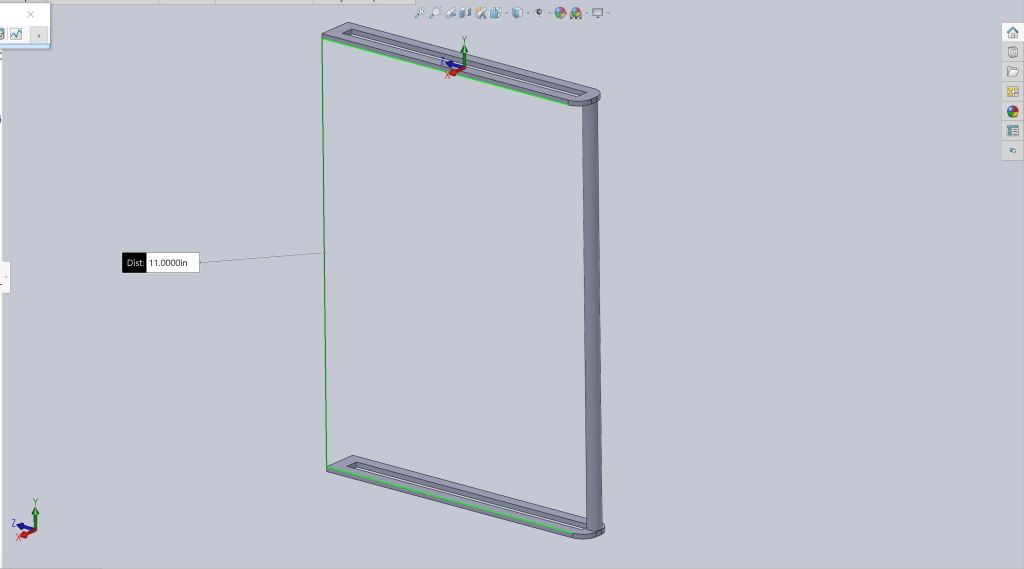
This bracket’s rod allows the door to pivot around it. The slots in the brackets slide back and forth in the frame of the box itself, allowing the door to move outward as it opens, providing room for the hinge to operate properly. This will be spring-toward the back of the box to both assist closing and keep the box seamless while closed.

The door (above) pivots on the rod on the bracket part and can pull out the bracket.
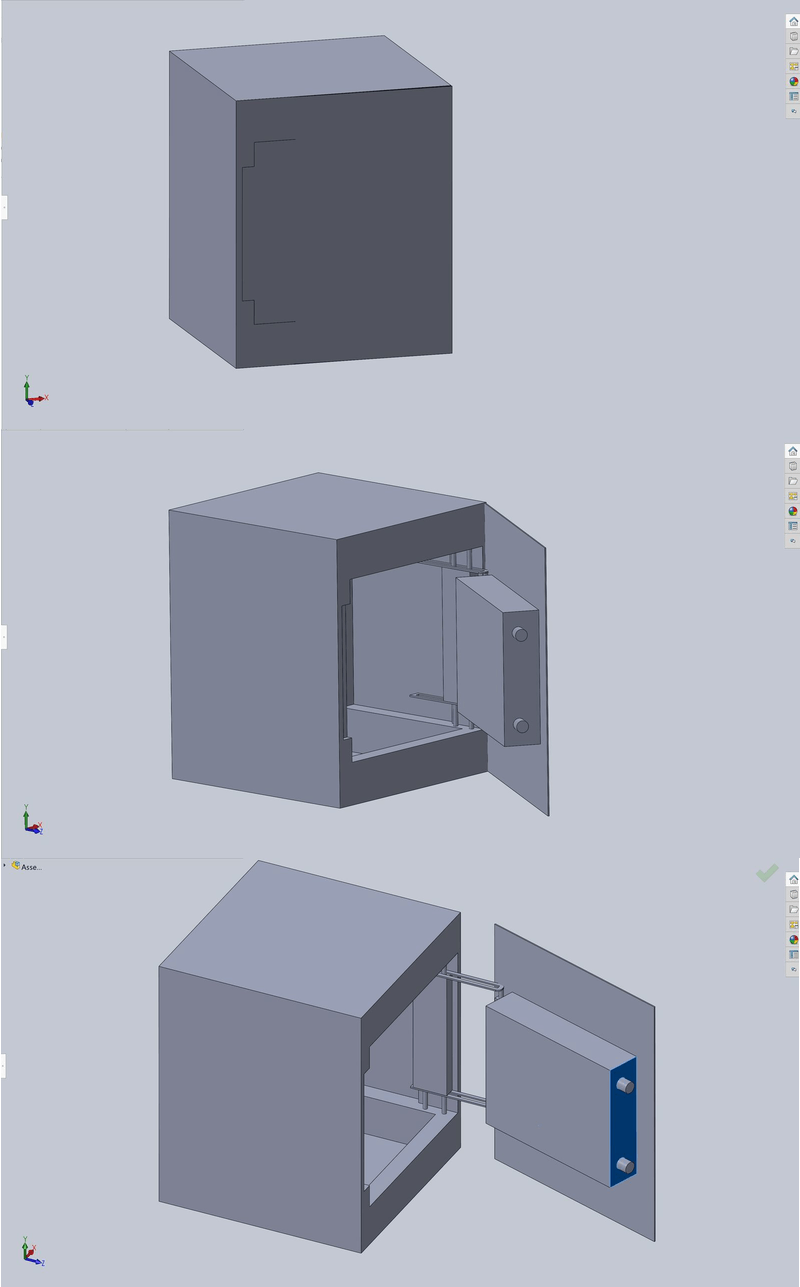
As illustrated above, as the door opens, it slides farther out to allow full pivot of the door’s hinge.
I plan to use solenoids to pop the door ajar in operation, and the user opens it the rest of the way.
Material Selection
I have chosen a material for the exterior of the box. After comparing the results of 6 combinations, I have made a selection.

The options I was considering for exterior paneling were (illustrated above) galvanized sheet steel (plain) or with matte or semi-gloss black paint. The other options were acrylic (plain) or with matter or semi-gloss black paint. I have selected semi-gloss black painted galvanized sheet steel. It is inexpensive, and relatively easy to work with. To ease my efforts. I will look into the costs of having the pieces I need laser cut in a shop after I have final frame dimensions.

One problem I anticipate with the sheet metal, is that it is relatively malleable when not backed by a rigid material. I will counteract that by filling the space in my frame with structural backing. For the door, I plan to back the sheet metal with HardBoard compressed Masonite.

Software
After a consultation with a technical advisor of mine, I concluded I will be using Twilio’s resources to operate my software. Twilio offers an API and phone number plan to use SMS messages through the internet.
I have found a tutorial to help set a raspberry pi up to operate its GPIO (pins) using an SMS message from your phone.
https://www.instructables.com/Text-Controlled-Raspberry-Pi/
I plan to use Python’s web framework DJANGO to operate my Pi with the web.
Time Management
Week 3 Goals (in order of precedence):
CAD model(s): 6 hours
Material Sample Testing: 3 hours
SMS refresh: 2 hours
Misc. other stuff that could come up: 1 hour
email Stephanie: practically no time at all maybe 5 minutes
Feedback: keep doing what you’re doing
Week 3 actual time use:
CAD model(s): 9 hours
Material Sample Testing: 2 hours
SMS refresh: 1 hours
The CAD model took much longer than anticipated, but I also finalized my design in the process. I finalized my material selection after some trips around campus and hardware stores for supplies. I have a clear cut direction on what to do for software now that I consulted an advisor.
I emailed Stephanie, and things are looking good for deployment. Need to get back to her this week.
Project outlook: Great!

